Monday, 18 November 2013
Reading Buber, and thinking about love


Wednesday, 9 January 2013
Writing and art
Friday, 14 December 2012
2012 in Music
I've bought more music this year than for a long time. I came back to the vinyl fold, initially buying a 99p usb turntable off Ebay (which didn't work) and quickly afterward collecting my battered old Vestax from storage at my parents' house. In a way I regret it, because vinyl's so much more expensive and unecological than CD...but, it does sound (and feel) fantastic. So much for my eco-credentials.
A shout out should be given to Nottingham's Music Exchange. The only independent store in Nottingham, they are run by homeless charity Framework, support vinyl and new artists and sometimes have live shows instore. Needless to say, musicians can't survive and carry on making the music we love if people don't buy their releases.
I've surprised myself by getting into extreme metal again. Well, for the first time really - apart from a teenage interest in Napalm Death and the rest of the Earache roster, I could never really dig the lack of emotional breadth or melody in much grindcore, and hated the overstatement of death metal. All that teenage phase left me with was a deep love for Mick Harris and James Plotkin, as well as a high respect for Godflesh. Really, two bands have sealed my embrace of the dark side this year: Dephosphorus - a Greek "astrogrind" band whose second full-length has garnered rave reviews from around the web. It's beautiful, both physically for its art and presentation, and aurally. Brutal, abrasive but intelligent; psychedelic and furious, but controlled. There's been a massive proliferation of screamy, sophisticated-ish black metal awash with blastbeats and all those same chords and sounds - Dephosphorus do something beyond that, and hopefully will continue to push the sound beyond the very narrow furrow it now inhabits.
The second band is This Gift Is A Curse, a Swedish band who I saw at the Chameleon. Thanks to a nice little group of music-loving friends this has become my regular haunt and I've discovered much great music here. I really can't fault it as an underground venue and the sound-system/sound-man especially cannot be praised highly enough. Anyway TGIAC make a brutal brand of occult black metal which pleases both the viscera and the intellect, being complex, blackened, gruesome and tight but never overly technical. Here's a band firing on all cylinders and pulling in the same direction. Just a shame about the drunk guy in the audience who kept annoying the singer by getting into the mood a bit too much.
Raime. Well, what can I say about Raime? After a string of well-received twelves they dropped their LP Quarter Turns over a Living Line late this year; it's stunning. Better, if you ask me, than the singles although I have to admit that I only heard Spotify's MP3s of their previous stuff. This is the release that sealed my love for vinyl. Digital has never sounded as rich as this, and never made bass that shakes out of the woofers like this does. It's very simple music, but full of soul and, as Boomkat put it, dread. I sometimes think about how perception of music changes over time and wonder how today's music will seem in ten or twenty years. I have no idea how Raime will sound - either seminal or curious transigent fascination, I'm not sure. On paper they don't do much different from Demdike Stare, but they remain so much more interesting and vital. Maybe when fashion has moved on, the smog will have left and revealed them as actually no different, but I suspect this album will remain some definitive statement on the mood of our times, as Autechre and Aphex Twin did the mid 90s. Kids don't sit in their bedrooms chilling and smoking on a sunday comedown anymore; they sit and feel intense insecurity about the future and their place in it, the collapse of ecological systems, terrorism, corporate politics and the ravaging of social infrastructure.
I'll remind you here of what I said about the vinyl. This clip just doesn't compare.
On the other hand, a group I discovered at the same time as Raime and loved briefly, are Tropic of Cancer. I find myself now bemused as to what the fuss is - they have one or two great tracks, but the majority of their work is very cheesy, and displays a conventionalism which belies the apparent underground veneer; behind the smog there's nothing there. I'm glad I didn't buy their massively overpriced 12", though I did cough up for the massively overpriced mini-LP split with HTRK. I don't regret that, as it does at least have one of their great songs on, and I'm still in love with HTRK. I realise now that I was partially incorrect last year in characterising them as austere though - it's the unusual mixture of austerity and decadence which makes them so fascinating and is sure to preserve the strength of their music in years to come.
This is one of the good ones.
This year has seen a real return to the dark in fact. There's a real sense of terror and doom in music right now that I don't remember at any point before - maybe the late 70s would be the last point it was this apparent. It was reading a review on Boomkat which made me understand the sudden, unprecedented rise of freeform music recently: it's a response to the collapse of bedroom electronica. The complete antithesis of sequenced, 4 minute, computerised beats&melody music has been the sprawling, organic compositionless sound experiments which have almost taken centre-stage in underground music the last couple of years.
Schneider TM's Construction Sounds LP is the height of the freeform trend for me. Recordings made from the construction works that surrounded his Berlin flat for several years, effected and made into a detailed sonic canvas incorporating melody and synthetic sound into the mechanical work which is always refined and never merely cacophonous. Pierre Schafer would be proud (maybe).
I discovered, later than many, The Haxan Cloak. His first album is beautiful - organic and gritty but with restraint, tension and without noodling. The follow up mini-LP sounded flat and digital in comparison. I hope he steps things up for the next release.
On quite a similar note, I've been interested in Richard Skelton's literary and musical output. A very talented man to be sure, and with a clear (and unique) artistic vision. I bought the Limnology CD/book package for my dad's birthday. It's a minimally designed collection of words, poetry and musings about rivers and inland water. I'm not sure he gets it, but I like it. I also bought A Broken Consort, which is more accomplished musically, though slightly on the weepy side for my tastes.
An honourable mention also should go to my friend Ben's micro-label Kiks/Girlfriend, specialising in tiny cassette and CD runs. His own SCKE release is worth looking into.
Finally in terms of sound art, Daniel Menche caught my attention, I think from a review in the Wire. His work is highly detailed, made up of field recordings of natural and man-made sounds composed into pieces. Layers and levels of soundoverlap and interpenetrate to an almost psychedelic degree. He has a massive catalogue all of which is worth listening to, but the two that I decided to part with cash for were Guts and Drunk Gods.
On the strength of being told it sounded like Daniel Menche, I bought a lovely 3CD box set by Small Cruel Party after a show at the Chameleon (Russell Haswell and Pain Jerk in fact). Less dense, perhaps slightly less composed, but still intelligently put together and much more than just noise.
Something a little more melodic: Silver Stairs of Ketchikan. I saw Thought Forms play at the Chameleon and liked their music - but the CD I bought turned out to be the long-running solo project of their guitarist. In fact it grabbed me more than their own show did - resolutely experimental without being weird for the sake of weird, playful and full of intrigue and a pure love of musical sound.
An interesting agenda is being pursued by Imaginary Forces, and his label Sleep Codes. Very limited releases on a variety of formats sitting somewere between abstract electronics and noise. Beats taken through a grinder so they take on abstract, unrhythmic quality. I was drawn into his sound by the excellent Resonance FM show Resonating Machines, which invited producers to compose thirty minutes of sound from the sonic tools of their favourite records. All episodes are available to download from his site.
Pop.1280 formed pretty much my only foray into verse-chorus pop music this year. Not really pop in attitude, but standard band music, these guys play a sneery, grim cyberpunk art-rock which has seen more than one comparison to Cop Shoot Cop. Their debut The Horror is beautiful and exactly what I needed. I hope they play the UK soon.
Although, I've been more than a little bemused by the similarity of their first video:
To one that my old band DisinVectant put together. Not content with taking the aesthetic sense and the scratchy VHS quality, they even feature the vocalist talking into a payphone!
And now a moan. I raved about Death Grips last year. Now I wish I hadn't. I managed to catch their soundcheck (half of Guillotine, wonderful) in Leeds last summer before leaving to catch the last train back; I was gutted, it would have been my favourite show of the year. I really wanted to see them. Soon after they anounced, and then unceremoniously cancelled, a show in Nottingham. When they finally returned to the UK recently they totally avoided us. They released two albums, I listened to them both once and probably won't bother again. Don't get me wrong: Guillotine is a masterpiece. Death Yon is awesome. The rest of the Ex-Military album I could happily never hear again. I recently picked up the vinyl version and sold it, unopened, for four times what I paid (best price I've ever got for a record actually). I don't regret it at all. I don't have a problem with their attitude, their disrespect for their record label (uploading the third album because of a petty dispute about release dates) or their fans (cancelling a tour to record said album, leaving many people with train tickets or even accommodation etc which were unrefundable). Artists are like that, and shouldn't base their decisions on anything other than their art...art should never be "for" the fans, this makes it a commercial, crowd-pleasing endeavour which is not true art. If you want entertainment watch X-Factor. But the lack of intrigue, the lack of challenge and the sheer lack of progression in their sound has left me feeling bored. Maybe I'll change my mind, it's not unknown.
Circle Takes the Square still haven't released their second album, more than a year after their Kickstarter project was hugely oversubscribed. It'd better be worth the wait. But, it was a pure joy to see them play in Birmingham all the way back in February.
I heard and quickly bought Michael Idehall's SOL. I know nothing about this artist, label or album but I really like it; definite elements of Coil here.
Although it's only a twelve, I think I should briefly mention the Regis and Ancient Methods collaboration Ugandan Methods, and their recent Cold Retreat, on Boomkat's own label. Quality industrial technoid grooves. I've been really impressed with Regis output recently and how he's refashioned Downwards into something much bigger than the Brum techno label it could have been.
Here is probably where I should also note Downward's So Click Heels compilation. The highlight for me is Deathday's opener (which actually reminds me of a Regis track from an obscure compilation called Exist)
And finally it would be remiss not to mention Swans' The Seer. Probably the year's most awaited and certainly most lauded album, I was surprised by the delicacy of some of it - not what I remember from Gira's previous work, though it's a while since I listened to anything except the first couple of Swans albums.
In the midst of all this there hasn't been much space for melody. That's something I hope will change next year, I do miss tunes.
Saturday, 31 December 2011
Music of 2011
HTRK - Work (work, work)
http://ghostly.com/artists/HTRK
The best of the year. This gets better every time I listen to it: black and silky, cold and jagged, simple and repetetive but deep and powerful.
Oyaarss & Friends - smaida greizi nākamība
http://oyaarss.wordpress.com/ues/
Funny that one of the best releases of the year is a free download. But this compilation demonstrates some intelligent, forward-thinking electronic music with attitude.
∆AIMON
Witchhouse? Yes. I wasn't impressed by the first things I heard from this scene but it's matured quickly and this act are one of the leaders, adding a heavy dose of veiled aggression and industrial attitude to the mix. They've released a few things this year, which I can't really pick one from.Cloaks - Versions Grain
http://3by3cloaks.blogspot.com/
Like a broken machine, this is the kind of electronic music I've been waiting a long time for. Industrial, cold, soulless - austere and beautiful. This is actually a remix album but it only just tops their own originals.
Circle Takes the Square - Rites of Initiation
http://ritualofnames.blogspot.com/
This is the first taster of the new CTTS album due to be released next year. It's great - I'm not sure it reaches the majestic peaks of As the Roots Undo, but time and repeated listening could prove me wrong. Anyway it's still miles ahead of much screamo which refuses to push the envelope - CTTS are endlessly experimental and their tracks are insanely complex.
Regis - Adolescence
http://downwards.tumblr.com/
Yes, it's another compilation. But it's awesome; ignoring it just wouldn't make this list accurate.
Swimming - Ecstatics International
http://swimmingband.com/
I saw these guys play a headphone show at a local cinema - great idea, and the music was amazing. It's unusual to make very catchy, pleasurable music which is still experimental and sounds genuinely unique - but they do it perfectly. The album's brilliant, they deserve big success.
Grouper - Water People
http://www.myspace.com/grouperrepuorg
I doubt anyone hasn't heard of Grouper this year. Without a turntable for the past few years I haven't been able to participate in the vinyl revival but thankfully this release was available digitally.
Death Grips - Ex Military

http://thirdworlds.net/
Another free download - probably everyone's already heard Guillotine but it's always worth hearing again. Mental abstract electronic hip hop.
Friday, 15 July 2011
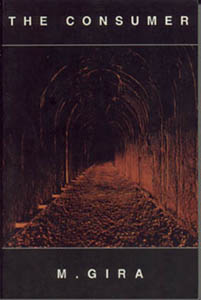
The Name of the Beast: Monstrosity and Self in Michael Gira's The Consumer.

(It should be noted that in this essay I'm only examining the second half of Gira's book, consisting of short stories from the mid-80s - not the longer first half).
The Consumer is an apt title for Gira's collection of short stories and meditative self-lacerations. The consumer not in terms of consumerism, but of consumption: that which consumes, katabolically dissolving and appropriating into itself, which stops at nothing to annihilate and integrate all that is before it. The book anyway is grotesque – but in the most beautiful possible way. Austere, laconic and surreal in style, its pages are filled with violence, disgust and abuse. Recurrent themes emerge across the stories from different angles: cannibalism, castration, rape, suicide, stench and a bizarre fascination with the Ouroboros-style physical loop.
It has been easy for reviewers to characterise The Consumer as filled with self-hatred. However, it is not as simple as this. The absence of any coherent self is reiterated throughout the book. The question which one feels while reading it, is a constantly repeated refrain of “What am I?”. The narrator - who switches easily between male and female, victim and aggressor, in search of boundaries - keeps pressing, pushing and flailing, while the forms we would assume dictate the cleavage of self and other dissolve around him.
The necessary implication of selfhood, that of establishing boundaries, hovers like a vulture over every piece. The boundaries between abuser or abused, perpetrator of violence or victim of it, are constantly questioned: the one who is suffering is perpetuating their suffering as a means of controlling the other; the abuser is in fact assaulting himself. Thus everyone in the book is a victim; even the perpetrators. The victim is always complicit in their subjugation and often the aggressor is clearly not the master of the situation or even their own actions. Sometimes it seems that there are no characters at all – only situations, playing themselves out.
The concealed crux of the book is naming – or rather the lack of names. There are none, no character in the book is named, other than occasional titles: 'the cop', 'the worker', 'my grandmother', etc. This only becomes clear over time, as one becomes increasingly entrapped in the book's world where identity is so difficult to establish. We find ourselves also lost in a claustrophobic space where there seems to be nothing but the extended plane of heaving flesh. The absence of names indicates the absence of sufficient identity, and one feels that the narrator is actually in search of the containment that names provide. If only he or she could find some title other than you, me, he and she, some way of identifying individuals in a specific way, the need for boundaries would be satisfied.
In Initiate, the narrator crawls toward a furnace while being kicked and beaten by a cop. Eventually he collapses, unable even to explain his failure to move. He wakes, castrated and branded, suspended in front of a mirror and unable to look away from his disintegrating corpse. The cops slice meat from his thigh and eat it. Finally he muses, “I'm happy to have them eating me. Eventually I'll disappear. As I dissipate, they'll grow stronger. I'll feel myself pouring into them.” Likewise in Blind, the narrator's leg is painlessly hacked off and consumed before she is violated. As her assaulters bark like dogs, she is consumed, erased, by a redness, a heat into which she disappears.
Even when not consumed, the body is equated with meat, “Meat that eats and shits, moves when pushed, sleeps when tired, nothing else” he writes in Some Weaknesses, moments before slitting the cop's throat. This intrusion of the knife is the only thing which temporarily breaks the spell of mindlessness, and the cop awakens momentarily in surprise and, “For a second, he's not meat.”
Of course, all bodies are meat, and in The Consumer there is nothing but bodies: to talk of spirits or souls here would be a blasphemy. But the meaning of being eaten is more than this base physicality: it is, as the book's title suggests, consumption. The desire to be consumed, to be annihilated; to be eradicated within another - or conversely by another from within, because Gira recognises that the consumer is also seeking oblivion, seeking a state of blankness which can be overwritten by the objects he appropriates. The consumer is passive: a mere vessel, he does not merely make void that which he consumes but is himself voided by it.
The same is expressed in the theme of stench: often the narrator is obliterated by another's odour, or their own smell reaches out to infect the environment, as a virtual extension of their body. “I want my world, my body, to consist of her smell. After it has become me, I'll be held enclosed, like an insect in a huge fist, and crushed.” (The Caregiver). In A Grave the narrator acts like a disease, corrupting and consuming the space they inhabit until it is impossible to tell where the human ends and the bed or walls begin. For the lust-crazed narrator of Defeated, “The world's an immediate extension of my thoughts, my self hatred.” In lack of the simple solidity that names confer, it is impossible to grasp self- and other-hood. Without boundaries, all becomes one single, skinless entity. In the single paragraph meditation, “The Ideal Worker”, the narrator appears hollowed out and vacuous as he waits for instruction: “My only ambition is to become more pliable, more inert.” The superior dominates the worker and ultimately will “wipe my mind clean”.
“I'm malleable, shaped, soft.” (Defeated) The narrator is always pushing to find a point of resistance that never comes, a concrete wall, anything real and not fluid. Experiments with control, submission and domination are attempts to find where one begins and another ends. But this certainty is never given, and boundaries are never found. A Man takes this to its logical extreme, where physical boundaries between the body and the environment disappear, and the narrator seeks identification with another, in the process “ruining my awareness of myself.” Prior to this, the body is an alien presence, something uncontrollable, but whose very controllability reinforces its alien nature. When literally consumed by the woman's body, he can no longer tell who contains who or whether he or she ever existed, and concludes that paradoxically, “I'm using her body to kill my body.” This fluidity returns in The Boss: “He's not himself, he doesn't belong to himself. He's watching his boundaries dissolve as I control him.”. The narrator often turns in toward themselves, sealed as a kind of Ouroboros, as in Another Trap (“I'm a small thing, plotting suicide, sucking my toes.”), the heroine of A Trap who sucks her own nipples and the proposed fellatio-suicide of Bastard, (“If I had a cock I could suck it, committing suicide by poisoning myself on my own sperm.”). However, this is restated metaphorically in A Screw where “Everything else is superfluous...I need nothing, no one”. Here we can see that when as so often, the abuser experiences the effect of their attacks, they sense through the other and form an intellectual Ouroboros, the only remaining sentience and whose actions can only affect themselves.
As anyone who reads the book will know, I have not been completely truthful. The book has one named character: Jennifer, in Daydreams. The shock of encountering a named person is jarring and conspicuous among the other texts and the effect of it is immediately obvious: Jennifer is a person, she is someone, not just a body, not just meat. We assume that 'Jennifer' has a life, friends and family and goes on holidays abroad. The recognition of Jennifer is shocking too for the reason that she is distant: all the other characters have appeared in claustrophobic proximity, slippery and in a constant state of flux as they perpetually violate and compromise each other - but Jennifer is contained and withdrawn. She is impenetrable, the name seems to form a wall between her essence and the narrator. She does not extend beyond it yet exists in projection behind it. Because she retains this integrity, actual interaction is possible - if unwanted: she repeatedly asks, “are you alright?” to the annihilation-seeking narrator who deflects her attentions. He had returned to the reality of his office job to find himself standing cruciform on his desk, staring into the fluorescent bulb centimetres from his face.
The absence of names on the other hand reduces characters to the behavioural moment. They have no history because they have no identity, and they have no internality because there is no criteria of differentiation between them and other bodies. The fluidity which is often expressed physically is also mental, as the narrator in A Contract finds it impossible even to tell whether his emotions are his own or are manipulations, whether his desires are natural or implanted and whether his memories are accurate. “When a thought comes into my mind, it warps and stretches out of its initial shape, changes into something else before I have a chance to recognize it as something I've made. I presume that I remember things but I'm not certain. I don't know if what I'm thinking is random (mine) or what I'm supposed to be thinking in order to satisfy their desires, to fulfil the prescribed influence of the environment they've put me in.” Thus while the other is often experienced as self, self is also experienced as other. Not only have boundaries disintegrated but internal consistency and integrity has broken down, because there is no external pressure to keep it together as a unity: “I have to second guess myself as well as them”, the invisible them who never appear but must be presumed to be in control of the environment and actions of the creature with whom he is locked into a destructive and sadistic performance. So, the boundaries of the self are constantly challenged, and while the self is always compromised and disempowered, it yet extends beyond its own confines. The I consumes everything and yet this I is an alien even to the one who should claim it. The relation between action and intention are endlessly questioned and reiterated, as the narrator questions whether they could have instigated their own, or asserts that another's are under their control. The desire for separation is made explicit in Money's Flesh, which claims “I want you to hold me down, keep me back, keep me away from the part of yourself where you exist.”, and yet “I want you to annihilate my perception of myself when you fuck me, treating me like flesh between your fingers.” This is the logical end of the desire to find boundaries: membranes are damaged in the search for some solid, impenetrable thing, abuse is sought as a method of locating that which suffers it and ultimately the questionable selfhood must be annihilated if that is the only way to prove that it ever existed. Boundaries are so fragile that even a glance is experienced as rape (Caregiver and Some Weaknesses).
The search for self is the search for other, because for one to have any meaning it must be contiguous with the other. The role of naming in this is very interesting: A name is meaningless if no one knows it. A name can only be used of another, it requires multiplicity, and effectively creates identity. The paper I submitted for Bamidbar will investigate these issues of the magical power of naming further.
Sunday, 12 September 2010
Regarding the burning of sacred texts and double standards
But then I heard about this: Military burns unsolicited Bibles sent to Afghanistan. Obviously this is not a simple inversion; the Bibles were burnt not out of malice, and not even by Muslims but by (nominally) Christian people who were concerned with protecting themselves and their colleagues.
I also don't think, as I've heard others say, the issue is that the Christian world has a greater intrinsic tolerance. I don't think this is true. History simply doesn't bear it out - Christian nations have committed at least as many massacres, forced conversions and human rights abuses as Muslim nations, and probably much more (the Second World War alone would probably settle this matter).
The real issue is the bizarre passive-aggressive stance the west takes. Western countries meddle in others internal politics, cripple them in abusive trade agreements and declare war when they can't see any other way to get what they want (and to remove leaders who they've groomed, who have got too big for their boots); but we are very eager to put on a show of not disrespecting their religion. So, the American government makes public pronouncements against a tiny Church burning the Koran for fear of upsetting Muslims. While quietly in those Muslim countries, the Bible is burnt, for fear of upsetting Muslims. "Burning another peoples' holy scriptures is completely unAmerican" says Obama, while his military burns their own.
If the (post)Christian west was so concerned with actually being disrespectful, wouldn't fair foreign policies be more to the point? Or would that be too subtle for Middle Eastern Muslims to understand? Isn't it more likely to be the perpetual political meddling and economic imperialism which are causing people to want to revolt in the first place, and the surface symptoms of intolerance such as Koran burning are only sparks which set off a tinderbox?
I've heard a few people argue that Christianity forms the most humanistic expression of religion, because of the Gospels' emphasis on love for humanity and freedom over dogma or a specific, strictly-defined culture. I'm quite dubious that this is really the case, though certainly there is a less deterministic ethic in the Christian paradigm; by concentrating on people's internal attitude rather than their external behaviour, by concentrating on the universal of humanity rather than cultural stability, the individual is given a higher value than the community (and the mind rather than the body but that's -ostensibly?- a different argument). This notion seems to have conditioned our society for both better and worse, such that all individuals are given equal moral value but at the expense of any respect for culture, for the whole of a society.
Christians of course are not up in arms about the Bible being burnt in Afghanistan. Part of this is because of the reasons I mentioned earlier (it wasn't done maliciously by an 'other' intent on defamation); part of it is also because because such a reaction is no longer part of our culture. We no longer see the text itself as holy. Rather it is the spirit behind it, the moral lessons, separated from any theological principles. A third factor is that of power: the (post)Christian west exists inexorably in a dominant relationship to the Islamic Middle East, and therefore events are always skewed in our favour. The fact that there is an American/European military presence in the Middle East, while there is no such Middle Eastern military presence in Europe or America means that the west is in an undeniable position of superiority, and knows it. Inexcusibly awful statements are made on a regular basis about Jews in the Islamic Middle East, because of this fact and perceptions about the relationship between the west and Israel (it's not the issue here and I'm not commenting on the correctness or otherwise of the perceived relationship - only that it is perceived); quite possibly defamatory statements or actions are made about Jewish or Christian scriptures in the Islamic Middle East (it seems unlikely they are not); but the public judgment will ultimately always be that they are not as dangerous as western defamations of Islam, for the same reason that the rhetoric of the Black Panthers or Nation of Islam was never seen as quite as awful as the KKK (despite at points being almost identical); the oppressed have a right to retaliation whereas the oppressors do not have the right to continue their spiritual whitewash.
If you're wondering what my point is, then you're in good company. I'm still trying to work it out
myself. The tendency to think in black and white rather than shades of grey is incredibly seductive and presents a challenge to us all. This is particularly true in terms of the Middle East, where oppression is conducted in almost every combination imaginable, but where people are often quick to shout about rights and wrongs. Interestingly, I've seen little (in fact, nothing) on Facebook recently about the plight of the Roma evicted from France. A people without a nation, expelled from the country they've made their home - where have we heard that before..? Has even Europe really learnt its lessons?
Saturday, 22 May 2010
Salvation and Christian typology in Philip K Dick
The androids, conversely, don't care. When media celebrity Buster Friendly exposes the fraud, they mock human empathy (typified in the fusion with Mercer provided by the ubiquitous 'empathy machines') as a hoax, one proved false by the swindle of Mercerism. But the final proof of Mercer's 'untruth' is negated by Isidore's experience as a result of the androids' mutilation of a spider he found outside. Wild animals are extremely rare in the poisoned earth, and cherished by the philosophy of Mercerism. Just as Isidore is saved by the false messiah of Mercerism, so is all reality; all of creation is resanctified, death is defeated and life returns.
Just as in this process, even the tomb world is essential (the appearance and experience of death is necessary for the salvation, when death is revealed as conditional), so the bounty hunter Rick finally realises his wife Iran's meaning: Iran had claimed that depression was a healthy human reaction to some conditions, one necessary to a full human life. The absence of such a correct reaction to the sterile world, abandoned and devoid of life, that surrounded them, she identifies as an archaic mental illness. This flattening of affect typifies the androids as well as the pathological bounty killer Phil Resch who is consistently mistaken for an android; an absence of any emotional depth or resonance which is in fact the problem of the novel's world.
Rick identifies in himself a defect: he has begun to identify with some androids. Phil Resch has no such problem. Although Rick initially feels this overactive empathy as a horrifying mutation, a symptom of dust-infection, it slowly becomes clear that it is not him but the world which is wrong: the cold world, devoid of compassion, involved in a constant struggle to tell androids from humans when even some humans are pathological. Even Isidore, a cripplingly mutated chickenhead, demonstrates his superiority to the androids in his response o the spider - he is terrified by their curious desire to experiment on it, and it is Mercer, the false prophet, who saves them both.
Philip K Dick lived during the last half of the 20th Century, the period when Christianity began to be popularly reduced to the status of a falsehood under speculations about the historicity of Jesus. Dick's own interest in the early Gnostic mythology of the Nag Hammadi texts evidences a belief in the power of myth to guide our lives, and reimbue reality with a sense of meaning and purpose. In Do Androids Dick fully realises the potential of myth as an element of human thought to again bring life to a dead and cold world: Rick finally realises that, in his own identification with Mercer, he has become immortal, identified with an archetype who, despite his literal falsity, is imbedded in human consciousness. Mercer, as the name suggests, is a personification of mercy - mercy to all life, and to that we may call the soul of reality.

 Posts
Posts