Friday, 15 July 2011

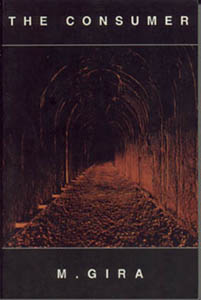
The Name of the Beast: Monstrosity and Self in Michael Gira's The Consumer.


(It should be noted that in this essay I'm only examining the second half of Gira's book, consisting of short stories from the mid-80s - not the longer first half).


The Consumer is an apt title for Gira's collection of short stories and meditative self-lacerations. The consumer not in terms of consumerism, but of consumption: that which consumes, katabolically dissolving and appropriating into itself, which stops at nothing to annihilate and integrate all that is before it. The book anyway is grotesque – but in the most beautiful possible way. Austere, laconic and surreal in style, its pages are filled with violence, disgust and abuse. Recurrent themes emerge across the stories from different angles: cannibalism, castration, rape, suicide, stench and a bizarre fascination with the Ouroboros-style physical loop.


It has been easy for reviewers to characterise The Consumer as filled with self-hatred. However, it is not as simple as this. The absence of any coherent self is reiterated throughout the book. The question which one feels while reading it, is a constantly repeated refrain of “What am I?”. The narrator - who switches easily between male and female, victim and aggressor, in search of boundaries - keeps pressing, pushing and flailing, while the forms we would assume dictate the cleavage of self and other dissolve around him.


The necessary implication of selfhood, that of establishing boundaries, hovers like a vulture over every piece. The boundaries between abuser or abused, perpetrator of violence or victim of it, are constantly questioned: the one who is suffering is perpetuating their suffering as a means of controlling the other; the abuser is in fact assaulting himself. Thus everyone in the book is a victim; even the perpetrators. The victim is always complicit in their subjugation and often the aggressor is clearly not the master of the situation or even their own actions. Sometimes it seems that there are no characters at all – only situations, playing themselves out.


The concealed crux of the book is naming – or rather the lack of names. There are none, no character in the book is named, other than occasional titles: 'the cop', 'the worker', 'my grandmother', etc. This only becomes clear over time, as one becomes increasingly entrapped in the book's world where identity is so difficult to establish. We find ourselves also lost in a claustrophobic space where there seems to be nothing but the extended plane of heaving flesh. The absence of names indicates the absence of sufficient identity, and one feels that the narrator is actually in search of the containment that names provide. If only he or she could find some title other than you, me, he and she, some way of identifying individuals in a specific way, the need for boundaries would be satisfied.


In Initiate, the narrator crawls toward a furnace while being kicked and beaten by a cop. Eventually he collapses, unable even to explain his failure to move. He wakes, castrated and branded, suspended in front of a mirror and unable to look away from his disintegrating corpse. The cops slice meat from his thigh and eat it. Finally he muses, “I'm happy to have them eating me. Eventually I'll disappear. As I dissipate, they'll grow stronger. I'll feel myself pouring into them.” Likewise in Blind, the narrator's leg is painlessly hacked off and consumed before she is violated. As her assaulters bark like dogs, she is consumed, erased, by a redness, a heat into which she disappears.


Even when not consumed, the body is equated with meat, “Meat that eats and shits, moves when pushed, sleeps when tired, nothing else” he writes in Some Weaknesses, moments before slitting the cop's throat. This intrusion of the knife is the only thing which temporarily breaks the spell of mindlessness, and the cop awakens momentarily in surprise and, “For a second, he's not meat.”


Of course, all bodies are meat, and in The Consumer there is nothing but bodies: to talk of spirits or souls here would be a blasphemy. But the meaning of being eaten is more than this base physicality: it is, as the book's title suggests, consumption. The desire to be consumed, to be annihilated; to be eradicated within another - or conversely by another from within, because Gira recognises that the consumer is also seeking oblivion, seeking a state of blankness which can be overwritten by the objects he appropriates. The consumer is passive: a mere vessel, he does not merely make void that which he consumes but is himself voided by it.


The same is expressed in the theme of stench: often the narrator is obliterated by another's odour, or their own smell reaches out to infect the environment, as a virtual extension of their body. “I want my world, my body, to consist of her smell. After it has become me, I'll be held enclosed, like an insect in a huge fist, and crushed.” (The Caregiver). In A Grave the narrator acts like a disease, corrupting and consuming the space they inhabit until it is impossible to tell where the human ends and the bed or walls begin. For the lust-crazed narrator of Defeated, “The world's an immediate extension of my thoughts, my self hatred.” In lack of the simple solidity that names confer, it is impossible to grasp self- and other-hood. Without boundaries, all becomes one single, skinless entity. In the single paragraph meditation, “The Ideal Worker”, the narrator appears hollowed out and vacuous as he waits for instruction: “My only ambition is to become more pliable, more inert.” The superior dominates the worker and ultimately will “wipe my mind clean”.


“I'm malleable, shaped, soft.” (Defeated) The narrator is always pushing to find a point of resistance that never comes, a concrete wall, anything real and not fluid. Experiments with control, submission and domination are attempts to find where one begins and another ends. But this certainty is never given, and boundaries are never found. A Man takes this to its logical extreme, where physical boundaries between the body and the environment disappear, and the narrator seeks identification with another, in the process “ruining my awareness of myself.” Prior to this, the body is an alien presence, something uncontrollable, but whose very controllability reinforces its alien nature. When literally consumed by the woman's body, he can no longer tell who contains who or whether he or she ever existed, and concludes that paradoxically, “I'm using her body to kill my body.” This fluidity returns in The Boss: “He's not himself, he doesn't belong to himself. He's watching his boundaries dissolve as I control him.”. The narrator often turns in toward themselves, sealed as a kind of Ouroboros, as in Another Trap (“I'm a small thing, plotting suicide, sucking my toes.”), the heroine of A Trap who sucks her own nipples and the proposed fellatio-suicide of Bastard, (“If I had a cock I could suck it, committing suicide by poisoning myself on my own sperm.”). However, this is restated metaphorically in A Screw where “Everything else is superfluous...I need nothing, no one”. Here we can see that when as so often, the abuser experiences the effect of their attacks, they sense through the other and form an intellectual Ouroboros, the only remaining sentience and whose actions can only affect themselves.


As anyone who reads the book will know, I have not been completely truthful. The book has one named character: Jennifer, in Daydreams. The shock of encountering a named person is jarring and conspicuous among the other texts and the effect of it is immediately obvious: Jennifer is a person, she is someone, not just a body, not just meat. We assume that 'Jennifer' has a life, friends and family and goes on holidays abroad. The recognition of Jennifer is shocking too for the reason that she is distant: all the other characters have appeared in claustrophobic proximity, slippery and in a constant state of flux as they perpetually violate and compromise each other - but Jennifer is contained and withdrawn. She is impenetrable, the name seems to form a wall between her essence and the narrator. She does not extend beyond it yet exists in projection behind it. Because she retains this integrity, actual interaction is possible - if unwanted: she repeatedly asks, “are you alright?” to the annihilation-seeking narrator who deflects her attentions. He had returned to the reality of his office job to find himself standing cruciform on his desk, staring into the fluorescent bulb centimetres from his face.


The absence of names on the other hand reduces characters to the behavioural moment. They have no history because they have no identity, and they have no internality because there is no criteria of differentiation between them and other bodies. The fluidity which is often expressed physically is also mental, as the narrator in A Contract finds it impossible even to tell whether his emotions are his own or are manipulations, whether his desires are natural or implanted and whether his memories are accurate. “When a thought comes into my mind, it warps and stretches out of its initial shape, changes into something else before I have a chance to recognize it as something I've made. I presume that I remember things but I'm not certain. I don't know if what I'm thinking is random (mine) or what I'm supposed to be thinking in order to satisfy their desires, to fulfil the prescribed influence of the environment they've put me in.” Thus while the other is often experienced as self, self is also experienced as other. Not only have boundaries disintegrated but internal consistency and integrity has broken down, because there is no external pressure to keep it together as a unity: “I have to second guess myself as well as them”, the invisible them who never appear but must be presumed to be in control of the environment and actions of the creature with whom he is locked into a destructive and sadistic performance. So, the boundaries of the self are constantly challenged, and while the self is always compromised and disempowered, it yet extends beyond its own confines. The I consumes everything and yet this I is an alien even to the one who should claim it. The relation between action and intention are endlessly questioned and reiterated, as the narrator questions whether they could have instigated their own, or asserts that another's are under their control. The desire for separation is made explicit in Money's Flesh, which claims “I want you to hold me down, keep me back, keep me away from the part of yourself where you exist.”, and yet “I want you to annihilate my perception of myself when you fuck me, treating me like flesh between your fingers.” This is the logical end of the desire to find boundaries: membranes are damaged in the search for some solid, impenetrable thing, abuse is sought as a method of locating that which suffers it and ultimately the questionable selfhood must be annihilated if that is the only way to prove that it ever existed. Boundaries are so fragile that even a glance is experienced as rape (Caregiver and Some Weaknesses).


The search for self is the search for other, because for one to have any meaning it must be contiguous with the other. The role of naming in this is very interesting: A name is meaningless if no one knows it. A name can only be used of another, it requires multiplicity, and effectively creates identity. The paper I submitted for Bamidbar will investigate these issues of the magical power of naming further.

Sunday, 12 September 2010

Regarding the burning of sacred texts and double standards

I'm beginning to think there's something a bit strange about the west's relationship with Islam. Forgive me if that's a truism. Like a lot of people I was insensed by the stupidity of Pastor Terry Jones' intended Koranic bonfire. Because I consider myself a liberal, and someone who believes in respect for other cultures, other belief systems and just in not pissing people off for the hell of it.

But then I heard about this: Military burns unsolicited Bibles sent to Afghanistan. Obviously this is not a simple inversion; the Bibles were burnt not out of malice, and not even by Muslims but by (nominally) Christian people who were concerned with protecting themselves and their colleagues.

I also don't think, as I've heard others say, the issue is that the Christian world has a greater intrinsic tolerance. I don't think this is true. History simply doesn't bear it out - Christian nations have committed at least as many massacres, forced conversions and human rights abuses as Muslim nations, and probably much more (the Second World War alone would probably settle this matter).

The real issue is the bizarre passive-aggressive stance the west takes. Western countries meddle in others internal politics, cripple them in abusive trade agreements and declare war when they can't see any other way to get what they want (and to remove leaders who they've groomed, who have got too big for their boots); but we are very eager to put on a show of not disrespecting their religion. So, the American government makes public pronouncements against a tiny Church burning the Koran for fear of upsetting Muslims. While quietly in those Muslim countries, the Bible is burnt, for fear of upsetting Muslims. "Burning another peoples' holy scriptures is completely unAmerican" says Obama, while his military burns their own.

If the (post)Christian west was so concerned with actually being disrespectful, wouldn't fair foreign policies be more to the point? Or would that be too subtle for Middle Eastern Muslims to understand? Isn't it more likely to be the perpetual political meddling and economic imperialism which are causing people to want to revolt in the first place, and the surface symptoms of intolerance such as Koran burning are only sparks which set off a tinderbox?

I've heard a few people argue that Christianity forms the most humanistic expression of religion, because of the Gospels' emphasis on love for humanity and freedom over dogma or a specific, strictly-defined culture. I'm quite dubious that this is really the case, though certainly there is a less deterministic ethic in the Christian paradigm; by concentrating on people's internal attitude rather than their external behaviour, by concentrating on the universal of humanity rather than cultural stability, the individual is given a higher value than the community (and the mind rather than the body but that's -ostensibly?- a different argument). This notion seems to have conditioned our society for both better and worse, such that all individuals are given equal moral value but at the expense of any respect for culture, for the whole of a society.

Christians of course are not up in arms about the Bible being burnt in Afghanistan. Part of this is because of the reasons I mentioned earlier (it wasn't done maliciously by an 'other' intent on defamation); part of it is also because because such a reaction is no longer part of our culture. We no longer see the text itself as holy. Rather it is the spirit behind it, the moral lessons, separated from any theological principles. A third factor is that of power: the (post)Christian west exists inexorably in a dominant relationship to the Islamic Middle East, and therefore events are always skewed in our favour. The fact that there is an American/European military presence in the Middle East, while there is no such Middle Eastern military presence in Europe or America means that the west is in an undeniable position of superiority, and knows it. Inexcusibly awful statements are made on a regular basis about Jews in the Islamic Middle East, because of this fact and perceptions about the relationship between the west and Israel (it's not the issue here and I'm not commenting on the correctness or otherwise of the perceived relationship - only that it is perceived); quite possibly defamatory statements or actions are made about Jewish or Christian scriptures in the Islamic Middle East (it seems unlikely they are not); but the public judgment will ultimately always be that they are not as dangerous as western defamations of Islam, for the same reason that the rhetoric of the Black Panthers or Nation of Islam was never seen as quite as awful as the KKK (despite at points being almost identical); the oppressed have a right to retaliation whereas the oppressors do not have the right to continue their spiritual whitewash.

If you're wondering what my point is, then you're in good company. I'm still trying to work it out
myself. The tendency to think in black and white rather than shades of grey is incredibly seductive and presents a challenge to us all. This is particularly true in terms of the Middle East, where oppression is conducted in almost every combination imaginable, but where people are often quick to shout about rights and wrongs. Interestingly, I've seen little (in fact, nothing) on Facebook recently about the plight of the Roma evicted from France. A people without a nation, expelled from the country they've made their home - where have we heard that before..? Has even Europe really learnt its lessons?

Saturday, 22 May 2010

Salvation and Christian typology in Philip K Dick

Philip K Dick's Do Androids Dream of Electric Sheep is one of the most powerfully - and genuinely - Christian books I've ever read. I don't say this lightly, not being a Christian myself but as someone who has on occasion felt the raw power of Christian mythology. I read it in a little under a week, and probably affected me because of the depression I've been in myself recently, one I saw evocatively echoed the descent of Isidore (the subhuman, mutated by the poisonous atmosphere of the earth) into the tomb world. As the real world collapses around him - literally it breaks apart at his fingertips - he finds himself in a subterranean place of bones, spiritless and unformed. But after an aeon life begins to emerge again, and takes him with it, and he realises that the origin of the person Mercer, this new world's popular messiah figure, is unimportant - the fraud has just been revealed as a conspiracy based around an unwitting and unknown actor - whether Mercer actually lived, or experienced any of the events people go through when they 'fuse' with him. He lives in human beings, in the people who look to and rely on him.

The androids, conversely, don't care. When media celebrity Buster Friendly exposes the fraud, they mock human empathy (typified in the fusion with Mercer provided by the ubiquitous 'empathy machines') as a hoax, one proved false by the swindle of Mercerism. But the final proof of Mercer's 'untruth' is negated by Isidore's experience as a result of the androids' mutilation of a spider he found outside. Wild animals are extremely rare in the poisoned earth, and cherished by the philosophy of Mercerism. Just as Isidore is saved by the false messiah of Mercerism, so is all reality; all of creation is resanctified, death is defeated and life returns.

Just as in this process, even the tomb world is essential (the appearance and experience of death is necessary for the salvation, when death is revealed as conditional), so the bounty hunter Rick finally realises his wife Iran's meaning: Iran had claimed that depression was a healthy human reaction to some conditions, one necessary to a full human life. The absence of such a correct reaction to the sterile world, abandoned and devoid of life, that surrounded them, she identifies as an archaic mental illness. This flattening of affect typifies the androids as well as the pathological bounty killer Phil Resch who is consistently mistaken for an android; an absence of any emotional depth or resonance which is in fact the problem of the novel's world.

Rick identifies in himself a defect: he has begun to identify with some androids. Phil Resch has no such problem. Although Rick initially feels this overactive empathy as a horrifying mutation, a symptom of dust-infection, it slowly becomes clear that it is not him but the world which is wrong: the cold world, devoid of compassion, involved in a constant struggle to tell androids from humans when even some humans are pathological. Even Isidore, a cripplingly mutated chickenhead, demonstrates his superiority to the androids in his response o the spider - he is terrified by their curious desire to experiment on it, and it is Mercer, the false prophet, who saves them both.

Philip K Dick lived during the last half of the 20th Century, the period when Christianity began to be popularly reduced to the status of a falsehood under speculations about the historicity of Jesus. Dick's own interest in the early Gnostic mythology of the Nag Hammadi texts evidences a belief in the power of myth to guide our lives, and reimbue reality with a sense of meaning and purpose. In Do Androids Dick fully realises the potential of myth as an element of human thought to again bring life to a dead and cold world: Rick finally realises that, in his own identification with Mercer, he has become immortal, identified with an archetype who, despite his literal falsity, is imbedded in human consciousness. Mercer, as the name suggests, is a personification of mercy - mercy to all life, and to that we may call the soul of reality.

Sunday, 14 February 2010

The problem of understanding meaning in postmodernism

Pascal Boyer's recent critique of deconstruction is worth reading. In it he challenges the often breathtaking statements of postmodern thought, claiming that these represent an elaborate bait-and-switch intended to ostentatiously cause shock while in fact masking a profound lack of meaningful claim.


I have sympathy with his attack and feel that these criticisms should be heard by those who jump eagerly onto the confrontational bandwagon of postmodernism. The reason I fel this is because they make the same mistake as Boyer. Thus, Boyer serves to highlight an easy and all too common misunderstanding, committed by advocates and enemies alike.


The interesting problem here is that Boyer's central argument - that postmodernist claims never mean what they say - is correct. Postmodernism should never be taken literally, for this is not its aim. Postmodernism seeks to disrupt the priveliging of literalist interpretations of reality; it attempts to disfigure that which claims a single truth which overrides the individual, and instead re-empower the human being or human consciousness over and above the material truths of science. The mistake comes when its own claims are understood as having the same meaning as those scientific truths. For, the attempt is not to dislodge and replace a literalist materialism with a different system. Rather, the attempt is to provide an alternative which can sit alongside the literalist convention, contrasting with it without the need to ascribe one or the other the sole criterion of value.


Lacan's statements that there is no such thing as sexual intercourse, or that the challenge to women is that they are not, should obviously be heard as metaphors which instigate a new appreciation of the categories society gives us, and a questioning of the relationships with people, events and objects which we tend to fall into (and even: the ideas we have of ourselves). If this is obvious for the kind of things Lacan says, it is more difficult to grasp in the case of other thinkers; and I have cause to wonder whether sometimes those thinkers themselves forget not to take their doctrines as literal statements about reality. I know I have often fallen foul of this, especially in the heat of debate.


It is a problem of dull, unsubtle thinking which can only take words as describing an objective, as-it-is world. Thinking at its most powerfully sublime, that which informs the practices of religion, art, philosophy, works precisely against this method. Instead of constructing valid descriptions of the world, it helps to dismantle invalid or constricting world-views. It allows people to question and reinvent their relation to the world, people, events and society in order to re-validate their lives.


The power of Derrida denying objective reality is lessened and devitalised when he is forced to admit that, in scientific terms, this is not correct. Both Searle and Boyer claim this as a victory, but I concur with Derrida himself that they have failed to correctly understood Derrida's project or intention. Admittedly, this failure is not a difficult one. Derrida is not talking scientifically, and should not be understood as doing so. But Searle seeks to place his thought within the scientific (which is the common-sense outlook of the 20th century west), thereby instantly negating Derrida's project by priveliging the literal description of reality over the poetic.


But we need the poetic to help us live. We need myths, we need the emotional power of new, human-centred narratives. It is my own opinion that this endeavour is what has informed the religious urge in humanity, as well as much of what we call philosophy - both the existential seeking of continental philosophy, and much of what came before. Thinkers such as Plato, the biblical prophets, Buddha, Mohammed, Jesus, Zarathustra, et al have sought to reconfigure the human understanding of our world and our place within it by constructing new metaphysical systems which privelige human values and ideals - of a specific kind - over the ossifying systems dominant in their own societies. I've attempted to argue several times in previous posts that religious doctrines are never meant to be understood in the same way we understand scientific claims about the world, but instead depict mythologically an approach to living which is meant to be used to enable us to live better; happily; more ethically. Therefore, these systems should be understood as a manifestation of the drive not toward literal truth, but toward authenticity as living beings.


To sum up, a quote from Keith Devlin's book I've just finished reading which I think illustrates this very well:

"In real life, who best understands a flower? The person who sees it with her own eyes, growing in the field? The photographer who chooses the best light and the best angle in order to transfer its beauty onto film? The painter who captures its subtleties on canvas? The poet who captures its beauty in words and likens it to aspects of the human condition? The blind person who perceives it by scent and touch? The musician who sees it swaying in the breeze and captures its motion in a melody? The botanist who knows how it germinates and grows? The biochemist who understands the chemical processes that keep it alive and give it colour? The biologist who knows what insects depend on the flower in order to breed and survive? The mathematician who writes down equations that describe the flower's symmetry? Surely, there is no one way to view and to understand a flower, nor even a unique 'best' way. There may be ways that are suited to a particular purpose, but that is another issue. In terms of understanding an aspect of our world, the more ways we have to understand a flower, the greater will be that understanding. The poet or the painter who remains ignorant of chemistry, biology, and mathematics is as deprived in his or her vision and understanding of the flower as the scientist who is blind to the flower's beauty."

(Goodbye Descartes, p.281)

Sunday, 7 February 2010

Horror and the European

Well it's been quite a while since I posted here, having been concentrating on my other blog. One issue I thought about though while Israel was race. Of course, this was prompted by the writings and thoughts of the African Hebrew Israelite Community. Ben Ammi's typifying of 'Euro-Gentile' culture, stemming from Greco-Roman culture and being essentially corrupt, damaging to the human spirit, in contrast to their own very positive and forward-thinking (and essentially holistic) lifestyle made me contemplate whether there are indeed any essential differences between white and black or European and African patterns of thought and approaches to the world. I wouldn't want to make any such statement myself (because such massive generalities would be intrinsically false and bound only to mislead) but while at Neot Semadar I had the time to read Collapse IV, the first article of which is George Sieg's article on the self-referentiality of horror. In this he analyses Zoroastrian traditions and HP Lovecraft to argue that horror is inseparable from the Aryan racist drive to purity. This article struck some chord with the thoughts I'd been incubating for the previous month. I'll record here what I wrote in my journal for posterity, not as a statement of any formulated belief or position I'd necessarily want to be associated with - just as an example of where some ideas can lead.

Horror, Sieg argues, is fundamentally dependent on reason: its emotional power depends on fixation upon more than what is currently present. In this it is an abject suffering based on the possibility of thinking beyond the immediate. It depends on concept-thought, on the capacity to abstract. Animals, he argues, cannot be horrified, only terrified. Horror, as the film genre can best suggest, is based on that which is not present but implied.

It occured to me while reading this that European culture could be typified by these qualities: the drive to abstraction, to concept-thought over and above contextualised or humanised thought. Ever since Greek times, Europeans have automatically strived to disassociate thought from matter; divine from life; pure from impure. This is precisely what Ben Ammi and his followers set out to address. Their lifestyle firmly relocates thought and holiness within the world and life as lived. Separation is the crime which European society has created. In religious studies we call this immanence.

In the dark pagan underbelly of western, Aryan-caucasian society, we have always had a clear and vivid conception of the horrific, of evil. Often this has been projected onto other humans, and has allowed us to treat other humans in ways unthinkably evil and horrifying. In our fear of other cultures, the unknown, the other, we have objectified them and sought to cartharise our fear onto them.

If the Aryan-caucasian is defined by abstraction, by logic and intellect divorced from the world and life, our capacity to feel, intuit and create horror is a part of our racial make-up, inseparable from our minds and thought-processes. To objectify the world, to think in terms of death - the Living God compartmentalised, boxed out of existence as the Shi'ur Qomah tradition (a Jewish one, oddly enough - though Bem Ammi would argue not Hebrew) does so beautifully. The holistic world disappears, that of life and action and emotion, surrendered for a thousand classifications, philosophy, science and reason, new methods to kill either physically or intellectually. In our science, life itself becomes an accident; consciousness an illusion and free will and morality anachronistic dreams from a long forgotten adolescent innocence.

Sunday, 23 August 2009

'Judaism', Christianity and the origins of 'religion'

A lot can be learned from Steve Mason's article on the origination of the term Judaism. I was unaware for instance that the term Judaism stems from a Greek word Ioudaismos which is almost exclusively Christian in its usage. Prior to the 337 appearance in Greek Christian texts, the only instances in Jewish literature are 4 in 2 Maccabees and 1 other in 4 Maccabees. (2nd and 1st century BCE respectively).

The author argues that the instances in 2 Maccabees demonstrate not a 'religious' use of the term but rather a practical cultural one. He compares the term Judaism to the term baptism - the latter meaning to baptise, the former meaning to Judaise. I.e., Judaism is used initially to mean the promotion and inculcation of Judaean culture and practice, in opposition to Hellenism (Hellenismos; also a term 2 Maccabees uses).

Of course, we are wise to remember that 'religion' is a relatively modern invention. Previously a peoples' 'religion' was inseparable from their culture. It was not a facet of life, but completely integrated into day to day and year by year living. The author argues that not only is 'paganism' as a religion or ideology a Christian invention, but so is Judaism as a religion. For writers such as Philo and Josephus, what they were describing was not an ideology but a living civilisation which contained and embraced philosophy, politics, commerce, festival, ritual, marriage etc.

Another interesting sideline that the author throws in is that Christianity faced much trouble during its first two centuries, precisely because there was no convenient social category as 'religion' - the Christians were a way of life without a history or homeland, more akin to a private club than the other cultures we may now characterise as 'religions'. Modern terminology makes invisible the vast categorical differences between these systems. Christianity thus appears to have been one of the first fully 'transferrable' ideologies (it occurs to me that Buddhism shares in all the same esential qualities also - predating Christianity by 600 years or so). Whereas nowadays we can easily comprehend what a 'religion' means in our society, and understand how it operates as a factor within multicultural society, a new ideological movement springing up from nowhere two thousand years ago would have been met with bewilderment by the populace. The same is clearly true in the early history of Islam, when Muhammad renounced the tribal practices of his forefathers in order to promote his monotheistic vision. 'Religion', it was claimed in both cases, was not something portable, not something that could be detached and passed around between individuals but a tradition and way of life that we inherit from our culture.

Of course, one is wise to know the difference between 'Christianity' (the ideology of the early church) and the teachings of the prophet Jesus. Jesus never intended to begin a new 'religion' (as we have seen, there simply was no such category in those times). His attempt, as best we can reconstruct it, was to refresh and revise the practice of Judaean culture in the face of the challenges from the Roman empire and Hellenic culture. The ideology of Christianity is largely a creation of the apostle Paul and the church which he made from the Jewish-Christian sect.

Sunday, 19 July 2009

Wittgenstein on Plato

I read "...philosophers are no nearer to the meaning of 'Reality' than Plato got...". What a strange situation. How extraordinary that Plato could have got even as far as he did! Or that we could not get any further! Was it because Plato was so extremely clever?
(Ludwig Wittgenstein - Culture and Value p.15)


Wittgenstein of course talks explicitly about other philosophers very little. This brief nod in the direction of philosophy's founding father should therefore be treated with great care in order to understand what is really being said.

I can see two interrelated issues for Wittgenstein here. The first is a criticism of Plato's own project. The second is a criticism of our own understanding of 'progress' in thought.

When Wittgenstein exclaims, "How extraordinary that Plato could have got even as far as he did!", he is mocking the notion that by thought we can approach an understanding of the 'real' world distinct from the everyday world we live in. What is this reality that we are seeking? 'How extraordinary that someone should even begin to understand reality!' The question not asked often enough for Wittgenstein is, what is this 'reality' we are seeking to understand? Philosophers often use the term as if it were something different from the actual world we live and breathe in, the world we see before us now and forever.

Similarly to Nietzsche, Wittgenstein inverts the antiquated western metaphysical tradition which places the essential before the actual: the abstract is an abstract from the present material world. Thus the task of attempting to reach the real via a process of intellectual abstraction, or via an examination of linguistic forms, is doomed before it starts. The real is present before us - in analysing it and refining it into its (apparently) general essence we are not approaching the truth of the matter, the "real" which is concealed by the corruptible form of the actual, we are in fact becoming increasingly lost in the sterile imagination.

Wittgenstein has often been understood as standing counter to the Cartesian tradition which separates the mind (the essential self or soul) from the body (the corruptible material presence). His own picture, which we can glean from his various writings, is thoroughly integrated. The self is not an ethereal gaseous substance hidden from the world by this dumb robotic body through which it must attempt to make its presence and wishes felt...no, the self is that which is made manifest in and through one's actions. The self is not squeezed into expression via the body, the mouth, one's speech and actions but is given life, made real by these potencies. His comments such as "The face is the soul of the body" (CV23) and "The human being is the best picture of the human soul" (CV49) serve to make clear his own approach to 'essentialism'. The essence is that which is realised (literally, made real) by the contingent. If we want to see a person's soul we should look at their actions - then we will see where their heart lies. If we want to see a person's experience of pleasure or pain, we watch their face and words through which these are expressed. These are not some phantom noumena which struggle to find their representation via the maze of body, they are naturally expressed, acted out; in a Hegelian sense, the phenomena is the final stage of 'becoming real' of the object. In two separate metaphors, Wittgenstein says "the work of art does not convey something else, just itself" (CV58), meaning there is no feeling which is the meaning behind the work, which the work exists to transmit; and "A picture cannot...depict its pictorial form; it displays it" (TLP2.172), meaning that the form or essence of a picture does not exist behind it, represented by the picture but exists in the picture, it is displayed in the picture itself.

How does this relate to Plato? Plato's attempt to essentialise the world and perceive the 'real' behind the phenomena is, to Wittgenstein, fundamentally misguided. It is the phenomenal which is the real and if we desire to understand it we cannot subsume it under some abstract system. The abstract can only be an etiolated version of the real; it is the real, once we have nullified the differences, the vibrancy, the temporality of actual existence. What we consider essential in things is in fact a statement of human value, and should not be mistaken for a quality in things themselves. The attempt to do so confuses and denigrates both the nature of scientific enquiry and the role of human value in thought.

The actual use of the word 'reality', how we use it in our language, does not denote something outside experience, but merely something outside clear delusion or confusion. To seek a non-subjective reality seems like a meaningful quest, but as the concept is analysed it disintegrates before us. Reality is this very world we live in together.

Similarly to 'reality', Wittgenstein sees 'progress' as a term which requires justification before we run in pursuit of it. It is easy in this age of technological and scientific progress to believe that progress is inherently beneficial, that it moves us ever only forward and upwards. To Wittgenstein, this is not at all clear. Progress implies a steady march, but this may not be in a direction which is good to pursue. Indeed, when a civilization has lost its sense of direction, 'progress' can seem like an end in itself, and the effects of such an ideal can become masked by the unquestioned perception that we moving 'forward'. He says, "that the idea of great progress is a delusion along with the idea that the truth will ultimately be known...It is by no means obvious that this is not how things are." (CV56)

Wittgenstein's own aim in his philosophy is not for movement at all, but for the kind of clarity which can only be found in perfect stillness: "Where others go on ahead, I stay in one place." (CV66). Instead of blurring the world by dynamic movement, he seeks to bring everything into sharp focus so we can see what surrounds us. Instead of building giant houses of cards, he examines the ground beneath our feet.

In this sense, we can see Wittgenstein's exasperation at our constant need to improve and develop our thought, as if we were progressing toward an actual understanding of reality. We have always been here. True understanding is not something we strive towards, but something we should stop in order to appreciate. We will not soon break through into truth, into truly perceiving the world or ourselves as they are...we must instead learn to see carefully and without self-imposed delusion what is right here. Through thought we can lead ourselves astray, through winding paths further and further from the actual world which should be obvious to us.