This is a response to The John Templeton Foundation's recent panel interview. Correspondents were asked to answer the question "Does the universe have a purpose?". Those interviewed were selected from a variety of disciplines, including astronomy, theology, astrophysics, biochemistry and computer science among others. The answers cover the entire spectrum from categorically No to certainly Yes, many opting simply for 'unsure' or 'possibly'.
The first thing that struck me about the question, was the fuzziness of what was being asked: It seems like a relatively straight-forward question, but once I begin to break it down, I find myself wondering who or what we are expecting an answer from – to which strata of 'reality' are we speaking?
My central point here is that in asking "Does the universe have a purpose?", we need to understand where we are locating the context of the question. Are we attempting to answer for the material structure that we inhabit, are we asking to the universe itself "Do you have a purpose, forget about our ideas, what do you say?"? Or are we asking within the sphere of human culture, does life have a grand (non-subjective) purpose, one imbued by our nature as conscious beings? Or, are we asking individually, do I experience purpose in my life?
These are all very different questions. The first, which many of the correspondents assume is the only angle, presents enormous difficulties. For there to be any 'objective' purpose to the universe (that is, one above and beyond human thought), we must needs postulate some grand power which defines it. As biochemist Christian de Duve points out, the idea demands some anthropomorphic creator-figure, one who has both the power and the will to determine Meaning for all creation. The question then becomes one of theology: an atheist must simply answer 'no', and a theist will almost certainly answer 'yes'. The problem with this interpretation, the objectification of Purpose, is that it forces us to attempt to see beyond our own minds. This begs the question of meaning: to even ask whether there is purpose outside of subjective consciousness is to attempt ourselves to assume a God's-eye-view on reality. How can we, as subjective, particularised minds attempt to state a truth (either positive or negative) outside of subjectivity?
Polymath Paul Davies' answer is particularly thought-provoking on this issue, reminding us that if 'purpose' is a solely human category (as chemist Peter William Atkins claims), then so is every concept employed in the practice of science: whenever we try to say anything about the world, we are applying human principles and ideas to 'objective' reality. Science (in fact, even perception) would be impossible without doing that. We are on a dangerous slope towards solipsism if we begin questioning the validity of concepts simply because they come from our minds.
There is a similar problem with astrophysicist Neil deGrasse Tyson's claim that bacteria would view the purpose of human life very differently from ourselves (ie as a mere food source/habitable environment): bacteria would give no answer to the question. I find it hard to believe bacteria could even ask the question. To do so is entirely a human enterprise: of all the world that we know, it is only humans who are 'meaning-making beings'. It is only us who find any need of the concept of 'purpose'.
So yes, of course 'purpose' presupposes a mind to conceive it, whether that mind is the cause of reality or merely the perceiver of it – but we must also ask, does not the term "universe" presuppose a mind to conceive it? In order for there to be a concept 'universe', there must be a subjective mind which is perceiving it and creating concepts based on it. Reality itself, stripped of consciousness, simply is: it makes no claims and generates no concepts. It is not merely the positive assertion of purpose which is beyond objective material reality, but also the negative denial of purpose: To stamp one's own anti-teleological preferences onto a mechanical system is to go far beyond what empirical evidence could possibly entail. As Lawrence M Krauss succinctly states, "The conclusion is in the mind of the beholder, and it is outside of the realm of scientific theory and prediction". Purpose (or lack of it) is a conclusion, it is not a property which can be investigated by material science.
Removing then the theological option, at the opposite end of the spectrum we have pure subjectivity. This third approach makes no grand claims beyond the subject's own opinion, localising the ability to claim purpose within individual consciousness and having no bearing on the structure of objective reality. But one feels this approach is something of an apology for human thought. It commits the same error as the first, in placing human consciousness as an isolated sphere within objectivity – it is subsumed by the 'grander' material Real World, that which is not merely personal opinion. This relativism places all opinions – whatever they are – on the same footing, effectively saying "make your own mind up – it doesn't actually affect anything anyway"
The universe we live in is one determined by culture and the broader social context. We do not live in a universe of particles, bouncing billiard ball-like, or one of quantum fuzziness. We live and act within a sphere of human value, human endeavour, one where organisms exist and interact as part of a web of meaning. Individuals have values, and experience reality through the conceptual substrata of social conditioning. It is this "noosphere", the realm of intellect (both conscious and unconscious, individual and collective) which we experience reality through: the conceptualisation of material properties happens culturally. We experience a cup, not a collection of atoms adhering to each other. We experience the joy and horror of global social events, not meaningless organisms bouncing off each other. It is this broad social context which confers meaning, and this which confers our sense of purpose. Surely, it is within this context that we must locate any search for the answers to this question?
Lawrence M Krauss opens the possibility of empirical evidence for divinely-ordained purpose through the medium of a cosmic "I am here" blazing across the sky. I contend that it is not an "I am here" we should be searching for, but the knowledge that We Are Here. The vain attempt to escape human teleological thinking and place meaning and purpose outside our own intersubjectivity, outside our own value systems, has left us bemused to find there is none. We find ourselves asking 'so we can find no meaning outside of what we think of as meaning?' What would we expect! Material science in this sense seems to want us to take measurements after throwing away the ruler! If we remove the influence of the subjective human mind from what we are perceiving, what data are we left with? What is there to be seen when we are eyeless?
Tuesday, 16 October 2007
Does the Universe Have A Purpose?


Thursday, 27 September 2007
The Value of the "Merely Human"
The problem with science -and what we must now try to counteract- is its disregard for the human mind, for experience, feeling and human categories. Although the theories of quantum mechanics do replace consciousness (or at least the conscious observer) to an important role in the cosmological scheme, we are still left with a somewhat etiolated appreciation of subjectivity. Value, morality, purpose - these things are still beheld as not existing in relation to the "most important" aspect of reality: the material. These things are given a cursory glance as evolutionarily-developed traits selected for their utility, at best something to be enjoyed during our time here, but ultimately not being intrinsically relevant to the world.
The value of religon in this sphere is that it sacralises precisely these "merely human" elements - these qualities are essential not only to human society, but are what the structure of the cosmos depends on. Most religions teach that value is determined outside of human thought, and therefore is a pre-existing structure which we must do our best to abide by - it, in fact, is why we are here. It is the measure by which we are judged. It cannot simply be abnegated by appeal to objectivity.
This centralising of the "uniquely human" is something we must cultivate. Not in the sense of placing humanity (as was implicit at one time) as the rulers of the cosmos, as the mark by which everything else is judged, but by accepting that the powers we have, which we have acquired (or indeed, which are handed on a plate to self-conscious,socially-organising beings such as humans), come with a responsibility to use them wisely, according to the traditions of morality and value which have been passed down to us.
Friday, 7 September 2007
The Golden Spiral
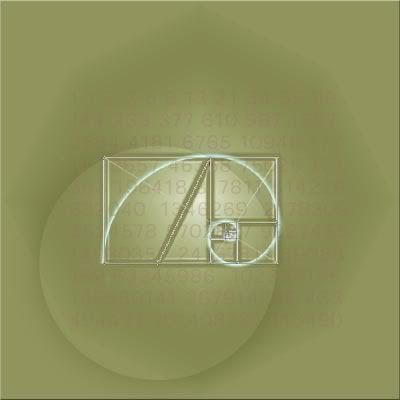
What I love about the golden spiral is the way it unifies the subjective and the objective:
On one level it is a phantom of the human mind, extracted from nature where it is presented to the intellect as a mere potential; not present, but an abstraction waiting to be realised. On the other, its beauty represents everything that is wonderful about the natural world, the organic perfection which can be represented numerically but only experienced through direct aesthetic means.
The root of the golden spiral is in number: the spiral itself was discovered by the manipulation of the Fibonacci Sequence. It demonstrates how the mechanical processes by which human intellect categorises form and seeks to limit objectivity, themselves contain the seed of beauty; for beauty itself is representative of subjectivity.
The debate rages on as to whether numbers are real, preexisting the human mind (preexisting matter itself?), or whether they are 'invented' by humans as a result of our experience of the world, but our knowledge of the golden spiral rests wholly on the articulation of number. Only later did we find nature also utilising the simple harmony of the patterns Fibonacci discovered.
Tne golden spiral represents the eternal relationship between abstract and effulgent. The fullness, the irreducible organic gestalt of objective reality generates in the human mind the need to abstract into universal forms and numbers; it is this mechanical numeric form which creates harmony and beauty as subjective experience. The tripartite, dialectical relationship between object, form and subject, or between matter, universal and mind. Discovered first within number and then within nature, prompting the question 'from whence does it originate?' The answer of course is that all exist within an eternal relationship. To place one aspect as temporally - materially - prior, and then claim the others as entirely generated, entirely caused by it, is to make an ontological/teleological prejudgment which assumes the importance of material temporality over, for example, logic.
The Moving Stairway

Is it madness to say of an escalator that it has language embedded in it? It is a creation of the thinking, rational element of the world (the noosphere, as Teilhard de Chardin named it), and as such it is an articulation and expression of our human-cultural paradigms. It manifests human conceptuality and exists solely for a teleological demand within human society.
The escalator belongs - in every aspect apart from its material nature - to the structures of the human mind. It has been created based on an idea, a purpose which was conceived by an individual, in order to serve a need present within society. Its genesis is not within itself but within thought. It is essentially a means of transport, but within its essence, its being, is a communicative act directly from one mind to another.
An apple holds no such message-bearing elements. It exists for itself and is utilised by humans to satisfy a need. But this role is secondary to its existence and nature. A moving staircase has its essence outside of itself, its essence resides in the noosphere as a communication of its intended usage. Its essence necessitates understanding, it demands human intellect for without human society it has no nature: Of itself it is nothing. Dead, inert and meaningless, an unnatural collection of molecules; something which cannot be produced via natural process and can have no end via natural process except decay.
And much, very much of the world we live in is the same. So much of our day to day lives are sunk within social conceptuality, we do not see beyond our miniscule cultural horizons. An escalator is just an escalator. We see the essence, we see the noosphere's concept, we do not see the reality. We forget there is anything beyond our cultural paradigms. Maybe this isn't a bad thing. Probably intellect demands that letterbox apprehension. The more we filter and abstract the more precisely we can think and further our human endeavours. But surely there is something to be said for the ability to stand outside and accept the madness of human culture; to appreciate the objective from some other perspective than the one we normally live in?
Why the Everyday World makes Sense
Some people seem quite confused by the discrepancies between microscopic (quantum) reality and macroscopic (everyday) reality. The fact that the quantum level doesn't follow our normal logic has caused a lot of trouble for scientists (and only slightly less for the general public).
How can a level of reality, that we experience in our everyday lives, make perfect sense when it is generated from a completely illogical, counter-intuitive level beneath it?
The answer has to do with the way we are looking at the problem: macroscopic reality must make intuitive sense. Our minds have developed precisely in order to form predictions about the everyday world. We experience reality at the level of tables, chairs, grass and human actions willed by other minds. Our grip on the world is at the macroscopic level, and over the millenia individual consciousness has developed in order to understand the world at the level where it is active. Our sensory apparatus filters and interprets the world, applying forms and categories to the seething mass of undifferentiated data which bombards us. From this, we isolate and extract narrative threads which allow us to act effectively in the world. We cannot dispute that there are other events going on that we fail to comprehend. There are other narrative streams which simply don't fit into our minds, which don't make it through the logic filter, and so we don't connect isolated events which, seen from another dimension of thought, would be a clear process of cause and effect.
For example, we think in only one temporal direction. We find it exceedingly difficult to view cause and effect running from the present to the past. But doesn't this say more about our minds and the way they work, than about reality itself?
The big question which this is leading up to, of course, is of the relationship between 'objective reality' and the subjective experience. But this is a topic for another blog.
Rationalism and Religion
The problem is, that there is metaphysics; and then there is metaphysics. It seems to me that the term is used indiscriminately to apply to two areas of thought which should be absolutely separate . It would be best to call one logic, and the other spirituality. It is unfortunate that the term applies as valid to the two equally. The difficulty is compounded by the fact that concepts generated within the one discipline can almost always be translated into the other with very little difficulty, although their implication is far from identical.
Terms like 'eternal', 'spirit', 'absolute' find use in both - and when a clearer definition is sought to clarify the nature of these concepts, we find ourselves still at a loss to understand of which area the speaker is referring. The idea of a non-physical entity - any non-physical entity - leads us into the same trap. Is the 'soul' an independent, real thing - or is it a word we use to refer to a quality we experience of someone? The word is still in common parlance as a metaphor. But what is the actual referent?
It has been argued that the majority of philosophers have in fact been talking of the 'realm' of logic: Plato, Aristotle, Hegel, Leibniz, Wittgenstein...all were talking of no 'religious' qualities: they sought merely to describe the difference between the material world outside of us, and the world of thought inside of us. The problem comes when philosophy and religion meet, and thinkers such as Maimonides attempt to explain religious concepts by means of philosophical concepts, and thus identify the two. Now, this blurs the line and we know longer know whether in fact there is a real difference between the religious God and the Absolute of the philosophers (although the distinction between the concepts should be intuitively clear to us); between the Soul of religion, and the Spirit of philosophy (or even the simple idea of a person's 'essence'); or between the angels and the metaphorical message-bearing elements of manifestation attested by Maimonides.
Are these concepts identical? Kierkegaard definitely didn't think so. An autonomous non-physical reality has no place in philosophy, but it is the essence of religious metaphysics, which postulates beings and actions which are real in precisely the way we are, while having no material presence. But where does the use of metaphor begin and end? Do the intelligent, the rational of today, understand the power of myth as metaphor for the logical concepts of philosophy and all the soft mind-based experiences of meaning? Was anything else ever meant by these words? Many still believe in the literal truth of angels, a personal God, and the afterlife. Are these people merely fools, those who cannot exercise logic enough to grasp the concepts behind the terms and so naively create a supraphysical realm which is clearly not 'there'? Of the Abrahamic faiths, no scripture talks of ought but this world we inhabit. The metaphysical interpretation has always come after, 'on top' of what is talked of in the holy books.
My problem is this: Surely one must be correct. If we explain away the difference by saying that one is metaphor for the other (as Hegel did, and Averroes and Maimonides before him), then that still leaves us with a literally corect understanding and a literally false one. If religion is a mythical, 'dreamlike' description of philosophical truths, then philosophical logic must take a higher place than religious revelation.
And in doing this, we strip God of any personhood whatsoever: by rejecting the anthropomorphic imagery in favour of a logical Absolute, we are effectively destroying the fundamental humanness offered by religion - and this is what so often has caused the downfall of rationalism, whether in Islam, Judaism, Christianity, or even Hinduism.
But truth must lie somewhere. Is it again too much of an anthropomorphism to demand that the universe has a conceivable structure that is graspable by humans? Or is it precisely this element of mystery, that mere mortals cannot perceive the whole of reality except from within our limited subjective experience of it, is it precisely this fact that makes being alive so unpredictably special?
Friday, 29 June 2007
The Laws of Physics and Flexi-History
In a nutshell, the author (along with several other leading physicists) believe that we have to stop viewing time as a straight line. The classical notion a timeline as immutable past leading inexorably into present, where the choices we make lead into a yet-to-be-decided future is looking increasingly dubious.
Instead, we have to focus attention on the present, the point which we as conscious beings inhabit. This of course would be no earth shattering news to those of the Indian religious tradition, who have always placed the focal point on the subjective 'now' of consciousness. It is a peculiarity of the west (and specifically of the Judeao-Christian tradition) that we attempt to understand time from 'outside'. Instead of placing our attention 'within', inbetween the fuzzy states of past and future, we attempt to begin from a precise objective point (where time began) and progress rationally along the continuum, admitting no difference in quality between our point of direct experience and those of memory/projective imagination. Of course, the rationalist timeline was first given expression in the Torah, the Jews placing the creation at an apparently definite, finite point in the past, from which time and reality has progressed quite happily until we reach the present moment. This was not always understood as a literal truth, mythology only having been reinterpretted literally in the last few hundred years (largely under the Christian/rationalist mindset which has created much of our current status quo). But I'm going to dismount my hobbyhorse because I want to briefly mention another interesting synchronicity before letting you read the article yourselves.
The numerical system provides some valuable insights into this new view of time: If we conceive the 'zero-point' as being the present moment of consciousness, we see that the negative integers and positive integers expand infinitely on either side of us. Given Georg Cantor's work last century on the number line and irrational numbers, can we project some parallel between the structure of infinitely divisible finite spaces (the interplay between rational numbers giving the number line its structure, and the irrationals giving the line its substance), and the unknowable complexity of the transcendental numbers, onto the quantum structure of time itself..?
The flexi-laws of physics
from New Scientist 30 June 2007
by Paul Davies
SCIENCE WORKS because the universe is ordered in an intelligible way. The most refined manifestation of this order is found in the laws of physics, the fundamental mathematical rules that govern all natural phenomena. One of the biggest questions of existence is the origin of those laws: where do they come from, and why do they have the form that they do?
Until recently this problem was considered off-limits to scientists. Their job was to discover the laws and apply them, not inquire into their form or origin. Now the mood has changed. One reason for this stems from the growing realisation that the laws of physics possess a weird and surprising property: collectively they give the universe the ability to generate life and conscious beings, such as ourselves, who can ponder the big questions.
If the universe came with any old rag-bag of laws, life would almost certainly be ruled out. Indeed, changing the existing laws by even a scintilla could have lethal consequences. For example, if protons were 0.1 per cent heavier than neutrons, rather than the other way about, all the protons coughed out of the big bang would soon have decayed into neutrons. Without protons and their crucial electric charge, atoms could not exist and chemistry would be impossible.
Physicists and cosmologists know many such examples of uncanny bio-friendly "coincidences" and fortuitous fine-tuned properties in the laws of physics. Like Baby Bear's porridge in the story of Goldilocks, our universe seems "just right" for life. It looks, to use astronomer Fred Hoyle's dramatic description, as if "a super-intellect has been monkeying with physics". So what is going on?
A popular way to explain the Goldilocks factor is the multiverse theory. This says that a god's-eye-view of the cosmos would reveal a patchwork quilt of universes, of which ours is but an infinitesimal fragment. Crucially, each patch, or "universe", comes with its own distinctive set of local by-laws. Maybe the by-laws are assigned randomly, as in a vast cosmic lottery. It is then no surprise that we find ourselves living in a patch so well suited to life, for we could hardly inhabit a bio-hostile patch. Our universe has simply hit the cosmic jackpot. Those universes that can't support life - the vast majority in fact - go unobserved.
Goldilocks enigma
The multiverse theory is a step forward, but it still leaves a lot unexplained. For a start, there has to be a universe-generating mechanism to make all those cosmic patches. There also has to be a process whereby each patch acquires a set of by-laws, perhaps at random, perhaps not. These requirements demand their own laws - which maybe we should refer to as federal laws or meta-laws - to govern the creation of law-driven universes.
In itself that is not an overriding objection. Cosmologists have concocted a way for an endless stream of big bangs to occur spontaneously throughout space and time, each triggering the birth of a "bubble" universe somewhere and somewhen in the boundless multiverse, with each bubble governed internally by its very own by-laws. However, their calculations appeal to quantum mechanics, relativity and a host of other conventional oddments from the standard tool kit of theoretical physics. Accepting such meta-laws as given - true without reason or explanation - merely shifts the mystery of the laws of physics in our universe up a level, to that of the meta-laws in the multiverse.
The basic difficulty can be traced back to the traditional concept of a physical law. Since at least the time of Isaac Newton, the laws of physics have been treated as immutable, universal, eternal relationships - infinitely precise mathematical rules that transcend the physical universe and inhabit an abstract other-worldly realm.
These perfect rules were supposedly imprinted on the universe - somehow - from outside, at the moment of cosmic creation, and haven't changed an iota since. In particular, the laws care nothing for what is actually happening in the universe, however violent the physical processes may be. So the universe depends on the laws, but the laws are strangely independent of the universe.
Four hundred years on, physicists still cling to this model of physical law, even though they have no idea what the external source of the laws might be. So long as science appeals to something outside the universe, we must abandon any hope of ultimately understanding why the universe is as it is. A large element of mystery will lie forever beyond our reach.
There is, however, another possibility: relinquish the notion of immutable, transcendent laws and try to explain the observed behaviour entirely in terms of processes occurring within the universe. As it happens, there is a growing minority of scientists whose concept of physical law departs radically from the orthodox view and whose ideas offer an ideal model for developing this picture. The burgeoning field of computer science has shifted our view of the physical world from that of a collection of interacting material particles to one of a seething network of information. In this way of looking at nature, the laws of physics are a form of software, or algorithm, while the material world - the hardware - plays the role of a gigantic computer.
Perfect past
The mathematics of the laws may be the same, but the change in perspective leads to profoundly different conclusions, as we discover when we ask just how powerful the cosmic computer may be. Every computer's performance is limited by the finite speed of its processors and the finite storage capacity of its memory. The universe is no exception.
Bits of information, even in the subatomic domain, cannot be flipped faster than a maximum rate permitted by the Heisenberg uncertainty principle of quantum mechanics. Meanwhile the storage capacity depends on the physical size of the observable universe, which is limited to the maximum distance light can have travelled since the big bang 13.7 billion years ago. From this, Seth Lloyd of the Massachusetts Institute of Technology in Cambridge has calculated that the observable universe can have processed no more than 10120 bits of information since its birth.
Does it matter that the universe commands only finite computational resources? Maybe not to the traditional view of the laws of physics, according to which Mother Nature computes the action of her laws in a transcendent heaven of infinitely precise mathematical relationships. But if we replace this highly idealised view with one in which nature computes in the real universe, then Lloyd's bound has serious implications. In effect, we have no reason to suppose any physical law can be more accurate than 1 part in 10120. Beyond that we can expect the law to break down and become fuzzy.
For most practical purposes Lloyd's number is so big it might as well be infinite. For example, the law of conservation of electric charge has been tested to only about one part in a trillion, still 108 powers of 10 too crude to reveal any possible breakdown arising from the finite information bound.
However, Lloyd's bound isn't fixed: it grows with time, and at the instant of the big bang it was 0. At the time the large-scale structure of the universe was being laid down during the first split second, the bound was still only about 1020 - possibly small enough to have cosmological consequences. So we are led to a picture in which the laws of physics are inherent in the physical universe, and emerge with it. They start out unfocused, but rapidly sharpen and zero in on the form we observe today as the universe grows.
Flexi-laws of this sort are not a new idea. They were proposed 30 years ago by the physicist John Wheeler. The way he expressed it is that the laws of physics were not "cast in tablets of stone, from everlasting to everlasting". Rather, they emerged over time, congealing from the ferment of the big bang.
Can the flexibility in the laws explain the Goldilocks enigma? Is there enough wiggle room for the universe to somehow engineer its bio-friendliness? Freeman Dyson, one of the pioneers in the study of the biological fine-tuning mystery, wrote that the more he learned about the various accidents of physics and cosmology that permit life to arise, "the more it seems that in some sense the universe knew we were coming". Dyson's dramatic assertion raises the obvious question: how? In the first split second, when the laws were in the process of settling down, how could the universe "know about" life and consciousness coming along billions of years later? How can life today be relevant to the physics of the very early universe?
Surprisingly it can, thanks to the weirdness of quantum mechanics. Heisenberg's uncertainty principle says that even if you know the state of an atom at one moment, there is an irreducible uncertainty about what its properties will be when you observe them at a later moment. One way of expressing this is to say that the atom has many possible futures encompassed within the overall fuzziness of quantum uncertainty. What's more, the principle works just as well for the past as for the future, so an atom has many possible histories leading up to its present state. By the rules of quantum physics, all these parallel realities must meld together to yield the present state of the atom.
The same general conclusion holds if we apply quantum mechanics to the entire universe - a subject known as quantum cosmology, made famous by the work of Stephen Hawking. Since we cannot know the quantum state at the start of the universe, we must work backwards in time from our present observations and infer the past.
As Hawking has emphasised, it is a mistake to think there is a single, well-defined cosmic history connecting the big bang to the present state of the universe (New Scientist, 22 April 2006, p 28). Rather, there will be a multiplicity of possible histories, and which histories are included in the amalgam will depend on what we choose to measure today. "The histories of the universe depend on the precise question asked," Hawking said in a paper last year with Thomas Hertog (www.arxiv.org/abs/hep-th/0602091). In other words, the existence of life and observers today has an effect on the past. "It leads to a profoundly different view of cosmology, and the relation between cause and effect," claims Hawking.
We can illustrate these abstract ideas from quantum physics with the help of a concrete demonstration suggested 25 years ago by Wheeler. His experiment is a variant of Thomas Young's famous 200-year-old double-slit experiment, designed to reveal the wave nature of light. A pinpoint source of light illuminates a screen punctured by a pair of parallel slits, projecting onto a second screen beyond. Light spreading out from each slit overlaps with that from the other. Where the light from both slits arrives at the image screen in phase, the waves reinforce to produce a bright band. Where they arrive out of phase, they interfere destructively, producing a dark band. The series of bright and dark bands are called interference fringes.
Mystery sets in when you turn the brightness right down. According to quantum theory, light may also be considered to consist of photons, which behave like a stream of particles. So what happens if you allow only one photon at a time to traverse the apparatus? Experiments show that although it takes a lot longer, an interference pattern does build up on the photographic screen, one photon at a time. Presumably each photon passes through only one slit, yet somehow it appears to "interfere with itself" and contribute to the pattern.
A wily experimenter might decide to place detectors at the slits to see which one each photon goes through. Nature, however, outmanoeuvres us. Whenever you determine the path of the photons, no interference pattern results. So you have a choice: look to see where the photon is heading and destroy its wavelike behaviour, or choose not to look, and allow the photon to manifest the wave aspect of its character. It essentially boils down to a choice of particle or wave. The photon can be both, but not at the same time. The experimenter gets to decide which.
So far so good. The novel twist that Wheeler added is that you can delay your decision to look at the wave or particle aspect until long after the light has passed through the slits. Using a pair of telescopes placed at the image screen, you can look back at the slits and infer which one any given photon emerged from. Do this and you destroy the interference pattern. In effect, the observation you make affects the nature of the past - specifically, whether the photon behaved as a wave or a particle. Physicists call this strange phenomenon "quantum post-selection".
There is a temptation to assume that the light "really was" either a wave or a particle in the past, but quantum physics denies this. It is simply not possible to ascribe a well-defined past to this system. Rather, your decision to make a particular observation - what Hawking meant by "the precise question asked" - determines the nature of the past. Crucially, however, the delayed-choice experiment cannot be used to change the past, or to send information back in time.
This aspect of quantum weirdness may appear startling, but it has been tested by experiments and found to be correct. In such experiments the quantum reach into the past is only a few nanoseconds, but in principle it could be extended to billions of years. And when it comes to quantum cosmology, it can penetrate right back to the big bang itself.
So how can this backward-in-time feature of quantum mechanics explain the bio-friendliness of the universe? Well, obviously we can rule out from the multiplicity of quantum histories any that don't lead to life, because that would conflict with the basic fact of our own existence. However, in the standard quantum cosmology advocated by Hawking, all of the alternative histories, without exception, conform to exactly the same laws of physics. So while a photon travelling from a source to a screen can take many different paths, the actual laws of motion that govern its path remain the same whichever route it takes.
Wheeler's idea was more radical. He claimed that the existence of life and observers in the universe today can help bring about the very circumstances needed for life to emerge by reaching back to the past through acts of quantum observation. It is an attempt to explain the Goldilocks factor by appealing to cosmic self-consistency: the bio-friendly universe explains life even as life explains the bio-friendly universe.
Flexi-laws
As long as the laws of physics are fixed, as they are in Hawking's cosmology, their enigmatic bio-friendliness is left out of this explanatory loop. But with flexi-laws of the sort advocated by Wheeler, the way lies open for a self-consistent explanation. The fuzzy primordial laws focus in on precisely the form needed to give rise to the living organisms that eventually observe them. Cosmic bio-friendliness is therefore the result of a sort of quantum post-selection effect extended to the very laws of physics themselves.
"As long as the laws of physics are fixed, their enigmatic biofriendliness is left out. Bring in flexi-laws and it's a different story"
Wheeler's ideas are far from properly worked out. They remain, as he quaintly referred to them, "an idea for an idea". However several theorists, including Yakir Aharonov, Jeff Tollaksen and others at George Mason University in Fairfax, Virginia, and myself are attempting to place the concept of flexi-laws and quantum post-selection on a sound mathematical footing.
How can we test these outlandish ideas? If the fidelity of the laws of physics really is subject to a cosmological bound, then the structure of the universe might betray some remnant of the substantial primordial fuzziness. A more direct test could come from the phenomenon of quantum entanglement, in which the quantum states of a collection of particles are linked in such a manner that an observation performed on one affects all the others simultaneously.
The key point about an entangled state is that it requires many more parameters to define it. For example, 10 atoms may have their spins aligned with or against a magnetic field. In a non-entangled state, you only need 10 bits of information to define the state for each atom. But if the atoms are entangled, you must specify the values of 210, or 1024, parameters.
As the number of particles goes up, so the number of defining parameters escalates. A state with 400 entangled particles blows the Lloyd limit - it requires more bits of information to specify it than exist in the entire observable universe. If one takes seriously the inherent uncertainty in the laws implied by Lloyd's limit, then a noticeable breakdown in fidelity should manifest itself at the level of 400 entangled particles. Such a state is by no means far-fetched. Entangled states of about a dozen particles have already been created, and experimenters have set their sights on 10,000 as part of the effort to build a quantum computer
In the orthodox view, the laws of physics are floating in an explanatory void. Ironically, the essence of the scientific method is rationality and logic: we suppose that things are the way they are for a reason. Yet when it comes to the laws of physics themselves, well, we are asked to accept that they exist "reasonlessly". If that were correct, then the entire edifice of science would ultimately be founded on absurdity. By bringing the laws of physics within the compass of science, and fusing nature and its laws into a mutually self-consistent explanation, we have some hope of understanding why the laws are what they are. In addition, we can begin to glimpse how we, the observers of this remarkable universe, fit into the great cosmic scheme.

 Posts
Posts